
Altars of Power: From Asia to the World. Religion, Politics, and Influence
Updated: Jun 4

Luigi Corvaglia
In August 2025, South Korean public opinion has been shaken by an unprecedented event: the former president and his spouse are simultaneously behind bars, both facing serious corruption charges. But this is not merely a case of political wrongdoing. At the center of the scandal looms the shadow of the Unification Church—now rebranded as the Universal Peace Federation (UPF) —and its ability to interfere in power dynamics.
This entanglement cannot leave another Eastern giant indifferent: Japan, where the issue remains alive and at the center of political debate. Indeed, in 2022, the assassination of former Prime Minister Shinzo Abe brought to light the long-standing and close ties between the same Church and the Liberal Democratic Party, fueling a heated controversy over the intersection of religion and politics.
For the Land of the Rising Sun, this is not the first time that the relationship between politics and religion has taken center stage. The spiritual movement Soka Gakkai has its own political party, the Komeito, which is allied with Abe’s party—and thus, indirectly, connected to the network of relationships involving the Unification Church.
The latter, in turn, represents one of the key nodes in a vast network of organizations that, under the banner of “religious freedom,” operates globally in close alignment with sectors of the conservative political world to oppose policies that might restrict the activities of controversial cults. What appears to be a strictly South Korean judicial case is therefore intertwined with a global network in which religious movements, geopolitical interests, and economic power move in unison, often in the shadows.
What follows is an attempt to shed light on this hidden backstage of politics.
Strange Bedfellows

The Moral Majority, founded in 1979 by televangelist Jerry L. Falwell, was one of the most powerful conservative evangelical political organizations in the United States. It sought to impose what it defined as the “foundations of Christianity” on national politics and therefore campaigned against abortion, homosexuality, pornography, and any form of détente with the USSR. In Ronald Reagan it found its political champion, playing a decisive role in mobilizing conservative Christians and helping secure Republican victories in the 1980s.
During those same years, while fundamentalist and Baptist organizations were mobilized by the Moral Majority, groups such as Christian Voice trained Pentecostal and charismatic pastors to “educate” their congregations on the “right” political choices, bring them en masse to the polls, and vote for candidates labeled as “moral.” Christian Voice distributed actual political “report cards” (“Report Cards” and “Presidential Biblical Scoreboards”), evaluating politicians based on pro-family, anti-abortion, anti-gay civil rights, pro-military, and anti-communist positions. These scorecards were highly polarizing and portrayed 1980s Democrats as “baby-killers,” promoters of child pornography (“kiddie-porn”), and advocates of the moral relativism of “New Age Globalism.” Headlines such as “Serial killers are homosexuals” could be found.
Many leaders of the Christian Right frequented the same media platforms and think tanks supported or influenced by the Unification Church, such as the Heritage Foundation, where regular meetings for ideological coordination were held.
Shortly after Reagan took office, Washington gained another daily newspaper to stand alongside the prestigious Washington Post: the less prestigious Washington Times, run by a former lieutenant of Falwell. The “strange” aspect was that its owner was Sun Myung Moon, the founder of the Korean Unification Church, who proclaimed himself the new Messiah. According to Moon, humanity fell when Eve had sexual relations with the fallen angel Lucifer, who later became Satan. As a result of this perversion of God’s love, all descendants of Adam inherited a corrupted bloodline and became alienated from God. God then sent Jesus Christ as the Messiah to redeem humanity, but the plan to purify the sinful lineage—by having Jesus marry and found a new divine family—failed. As a Plan B, God sent a new Messiah, Sun Myung Moon, embodying the Second Coming. The mass weddings that made the church famous were part of this plan: the idea was that two believers, chosen and matched by the Messiah, would produce children free from original sin.

The church founded by the self-proclaimed “Reverend” Sun Myung Moon is a vast economic empire that includes an automobile manufacturing plant and a massive industrial sector, as well as various hospitals and extensive real estate investments around the world. Among other things, it owns one of the largest seafood export companies globally and played a role in popularizing sushi in the United States—and from there, across the Western world.
Christian fundamentalists, therefore, found themselves allied with a group like the Unification Church, which proclaims as the only true family the community of “moonies”—the nickname given to its followers—and venerates its founder as a new Messiah. An apparent contradiction, yet when objectives align, religious zealots can prove surprisingly flexible.
Moon sought a newspaper to spread his cause and elevate his public profile. Neoconservatives needed a media outlet to assert their ideological orthodoxy on Capitol Hill. Thus emerged an alliance bringing together the Christian Right, conservative Jews, moonies, the radical wing of the Republican Party, and pro-market American think tanks. The The Washington Times was consequently staffed by ambitious young journalists, often willing to overlook basic journalistic ethics in order to follow the line set during Wednesday evening meetings at the Heritage Foundation.
The International Political Activity of the Unification Church
What emerged during those years was a form of mutual ideological and logistical subcontracting, in which the evangelical movement and the network of Sun Myung Moon fought side by side in the same “cultural war” against communism. The clearinghouse for this collaboration consisted—then as likely still now—of various pro-market Christian conservative foundations grouped within the Atlas Network, such as the Heritage Foundation. This pragmatic alliance also operated through parallel channels connected to intelligence structures.
The most important instrument used for this purpose by Moon’s Church was CAUSA, founded in 1980 after an exploratory tour in Latin America during which Moon’s right-hand man, Bo Hi Pak, met influential right-wing leaders and senior military officials.
Between 1980 and 1982, CAUSA organized ideological indoctrination seminars for politicians, military personnel, and other elites throughout the subcontinent. From a regional initiative, CAUSA soon became a global project, with activities on all continents. In 1983, CAUSA North America was established with the same objective: political training seminars in the United States. The antidote that CAUSA’s “anti-communist training” proposed against Marxism was “Godism,” a version of Moon’s philosophy stripped of its more explicitly religious or messianic elements. The central idea was that the struggle against communism is not merely political or economic, but a spiritual battle between the “God of Good” and satanic forces, with the Christian West (and implicitly Moon’s movement) as the vanguard.
CAUSA did not limit itself to propaganda. It is documented that it directly supported the CIA in supplying the Contras, right-wing militias engaged in anti-communist guerrilla warfare against the Sandinista government in Nicaragua. Ford Greene reports that CAUSA provided thousands of dollars and tons of food, medicine, and clothing to guerrilla troops. In 1985, The Washington Times—the Moon-affiliated newspaper—created a private fund for the Contras and announced that Bo Hi Pak, its publisher, had contributed $100,000 as part of an effort to raise $14 million. When asked how the newspaper could afford this, the publisher explained that its ownership (Moon’s organization) was ready to provide exceptional support in matters of great moral importance—namely, the fight against communism.
“As you travel through the backcountry of Central America, it is sometimes difficult to distinguish CIA agents from disciples of Reverend Sun Myung Moon. They appear to work side by side against Nicaragua’s communist-tainted Sandinista regime,” wrote Jack Anderson in the Indiana Gazette on August 16, 1984.
The extensive ties between the Council for National Policy (CNP), associated with leading figure of the American right Paul Weyrich—himself closely connected to the Brazilian traditionalist organization Tradition Family Property—and the Unification Church have been widely discussed in an AFN radio interview by Kelleigh Nelson with Chey Simonton.
These were the years immediately following the drafting, for the Council for Inter-American Security, of the Santa Fe Document, presented in 1980 to the Republican Platform Committee by a team of ultra-conservative advisers. The document stated that “U.S. foreign policy must begin to counter ‘liberation theology,’” that is, the “left-wing” theology developed by clergy in Latin America. It also highlighted work already undertaken in this direction:
“The experience gained in Vietnam, through planned population control programs, has been exported to Latin America and particularly to Guatemala by many agents of A.I.D. and other U.S. services. Certain sects have been created by psychological warfare specialists who were entrusted with controlling the political space and the hegemony of minds.”
The Santa Fe Document is explicit and leaves little room for ambiguity. It suggests that the United States, through agencies such as the National Security Agency (NSA), could foster “sects” capable of “controlling political space and the hegemony of minds,” with such efforts entrusted to “psychological warfare specialists.”
Koreagate and the Links with the KCIA
Even earlier, in 1976, the so-called Koreagate scandal erupted, involving ten Democratic members of the U.S. Congress accused of receiving bribes and favors from South Korean emissaries in order to influence American policy. At the center of the affair was the Korean Central Intelligence Agency (KCIA), created by Kim Jong Pil, who—according to CIA documents—during his tenure as director had “reorganized” the Unification Church, transforming it into a genuine political instrument.
In 1978, the Fraser Committee, a subcommittee of the United States Congress, investigated South Korean government interference in American politics. The Fraser Report revealed that the KCIA used the Church as a cover for clandestine operations in the United States and that it shared with it an anti-communist ideological vision. The regime of Park Chung Hee (1961–79) consolidated these ties, viewing the Moon network as a useful channel for exerting influence abroad. Among the strategic objectives was cultivating relationships with Richard Nixon and other American leaders to secure military and diplomatic interests, within the broader context of the Cold War and shifting Asian geopolitics.

The Japanese Case: From Nobusuke Kishi to Shinzo Abe
The ties between the Unification Church and Japanese politics date back to the 1960s, when former Prime Minister Nobusuke Kishi collaborated with Ryoichi Sasakawa and Yoshio Kodama—key figures in ultranationalism, but also linked to organized crime—to introduce and finance the movement in Japan. In the 1970s, Unification members worked for free as campaign staff for the Liberal Democratic Party (LDP), receiving legal protection in return despite their aggressive commercial practices.
This relationship was inherited by Kishi’s son-in-law, Shintaro Abe, father of Shinzo Abe. In 2022, Shinzo Abe was assassinated by Tetsuya Yamagami, who stated that he targeted the former prime minister because of his ties to the Church, which he accused of financially ruining his family (his mother, a devotee, had allegedly donated away their entire fortune).
The shock caused by the assassination sparked a national debate. However, according to Massimo Introvigne, director of the CESNUR (Centro Studi Nuove Religioni), the real victim—alongside Abe—was the Unification Church itself. In an article in The Journal of CESNUR, he argued that the moral instigators of the murder were the “anti-cult movement.” He wrote:
“[...] while the weak mind of the assassin had clearly been inflamed by campaigns against the Unification Church by militant lawyers and anti-cult activists, the latter succeeded in convincing most media, both in Japan and internationally, that the Unification Church, rather than being a victim, was somehow responsible for the murder, in a spectacular reversal of logic and fairness.”
The swift intervention of a group of Western scholars in defense of a controversial religious movement reminded some in Japan of what happened in 1995 after the Tokyo subway sarin attack carried out by the cult Aum Shinrikyo (“Supreme Truth”). Members of the group punctured plastic bags filled with sarin nerve gas inside Tokyo subway trains, killing 13 people and poisoning over 6,200. Some scholars associated with AWARE, including James R. Lewis and Gordon Melton, were reportedly paid by the group responsible for the attack even before arriving in Japan, along with other experts, to defend the cult—an advance payment for a pre-emptive defense.
On March 25, 2025, the Tokyo District Court issued an order to dissolve the Unification Church. The CESNUR and the magazine Bitter Winter described this ruling as a serious violation of religious freedom, contributing to shifting the focus from the substance of the allegations to the legitimacy of the procedure. This framing enabled the rapid internationalization of the case, linking it to a broader narrative of a “global crisis of religious freedom” and using it as a precedent to interpret developments in South Korea.
The Millions of the Universal Peace Federation to U.S. Politicians
In recent times, it has emerged that Donald Trump received about $2.5 million from the Universal Peace Federation (UPF)—the new name of the Unification Church—for three video appearances between 2021 and 2022. Former Vice President Mike Pence received $550,000 for a speech at a UPF event. The story was reconstructed by the Mainichi Shimbun by cross-referencing official U.S. documents with Japanese court records.
At the same circuit of events in 2022, Massimo Introvigne (CESNUR) also appeared, and if someone were to suspect that his compensation was likewise connected to the UPF, it would be understandable. In any case, this demonstrates how the Church’s political-religious network continues to buy visibility and legitimacy at the highest levels.

“Unification Church Gate” in South Korea
August 2025. Former First Lady Kim Keon-hee is arrested in Seoul on charges of corruption, stock market manipulation, and electoral interference. She is the wife of former president Yoon Suk-yeol, already in prison for insurrection and high treason following his attempt to impose martial law in December 2024.
According to prosecutors, Kim allegedly accepted luxury gifts from the Unification Church in exchange for political favors, inflated stock prices, and influenced candidate selections. The special prosecutor team led by Min Joong-ki expanded the investigation to the People Power Party (PPP), raiding its national headquarters on August 13, 2025, over alleged bribes linked to the Church. Names that emerged include the “shaman” Jeon Seong-bae and a senior Church official, Yoon Young-ho; chats and contacts point to mobilizations in 2023 aimed at infiltrating the PPP and steering its leadership in favor of Kweon Seong-dong, along with clear references to support for then-president Yoon.
Reconstructions identify a key moment in March 2022: the Church’s current leader, Hak Ja Han, reportedly publicly declared support for Yoon before Church cadres (Lotte Hotel, Seoul, March 2), triggering cash flows—“tens of millions of won”—to local PPP leaders to boost the campaign. Yoon Young-ho is said to have convened district heads to secure operational backing, promising political returns.
The political opposition openly refers to the affair as “Unification Church Gate.” For the Democratic Party of Korea, the PPP has effectively become a political subcontractor of a religious group. Spokesperson Baek Seung-ah described as “undemocratic and unacceptable” the use of money and religious structures to influence elections and political parties. The investigation—implicating Kim, Yoon, and several allies—thus goes beyond corruption, exposing an unspoken pact between political power and religious organizations that hold the state hostage.
All of this has prompted authorities to consider drastic measures, including the possible dissolution of the Unification Church. The prospect of liquidation in Korea has triggered an international counter-narrative portraying state and judicial actions as violations of religious freedom. In this context, CESNUR has played a central role in reframing the case in terms of human rights, through publications, interventions on platforms such as Bitter Winter, and appeals to international bodies—thereby shifting the conflict from a domestic judicial matter to the broader and more strategic arena of global legitimation of new religious movements.
Shincheonji
The “Unification Church Gate” is not the only occasion in which the People Power Party (PPP) has found itself at the center of allegations involving ties to controversial religious groups, as suspicions had already emerged in the past regarding connections with the Shincheonji Church of Jesus. Founded in 1984 by Lee Man-hee and known for its millenarian interpretation of the Apocalypse and aggressive recruitment methods, the group has often been at the center of controversy due to accusations of sectarianism and its use of front organizations—such as HWPL, IWPG, and IPYG—to present itself as a promoter of peace and interreligious dialogue. According to statements and journalistic investigations, the movement’s leadership allegedly mobilized tens of thousands of followers to support Yoon Suk-yeol in the PPP primaries, demonstrating the group’s ability to influence political processes through the organizational weight of its members. Former Daegu mayor Hong Joon-pyo wrote on Facebook: “I was told by Shincheonji leader Lee Man-hee around August 2022 that he had helped then-candidate Yoon Suk-yeol by having more than 100,000 Shincheonji believers join the PPP.”
As early as 2003, suspicions had been raised about the organization’s involvement in the convention of the Grand National Party (the predecessor of the PPP), and in 2007 a document was submitted to prosecutors showing that the church encouraged its members to join the party.
The issue became intertwined with the scandal involving the PPP’s ties to the Unification Church, to the point that, overwhelmed by the accusations, the party leader attempted to push back by calling for investigations into alleged links between the Democratic Party of Korea and Shincheonji. Indeed, broadcaster Kim Eo-jun revealed that Shincheonji had intervened in the Democratic Party’s 2021 presidential primaries, which were overwhelmingly won by Lee Jae-myung.
During the early phase of the COVID-19 pandemic, the Shincheonji Church of Jesus was identified as one of the main outbreak clusters in South Korea, particularly in Daegu, and was accused by authorities of violating emergency health management regulations. Apologists of “religious freedom”—led by Massimo Introvigne—rushed to defend the movement by producing a “white paper” portraying it as a scapegoat of the health crisis. Inconveniently for them, shortly afterward leader Lee Man-hee publicly apologized, kneeling before the media and acknowledging moral responsibility for the spread of the contagion among his followers.

Soka Gakkai
The political infiltration of the Unification Church in Japan is not the only case of close ties between politics and spiritual movements in the country. Another religious phenomenon of enormous power, with deep political roots and international reach, is Soka Gakkai, which—rather than aligning with a political party—chose to found one of its own. It is a Japanese Buddhist movement inspired by the teachings of the 13th-century monk Nichiren, led until a few years ago by the charismatic (and controversial) Daisaku Ikeda, around whom a veritable personality cult was built.
Soka Gakkai bases its doctrine on an exclusive interpretation of the Lotus Sutra, centered on the mantra Nam Myōhō Renge Kyō. According to other Buddhist schools, the movement distorts the meaning of Buddhism: instead of eliminating desires, it encourages them, promising that chanting the mantra will bring financial success, career advancement, and even sexual fulfillment. In 1991, Nichiren Shoshu, the main Nichiren Buddhist institution, formally excommunicated Soka Gakkai for doctrinal deviations and a series of controversial behaviors. The expulsion also involved Ikeda and had significant legal and symbolic consequences.
Despite its declared religious nature, Soka Gakkai has accumulated a considerable economic apparatus, including media outlets, publishing houses, educational institutions, and investments worth hundreds of millions of dollars.
As early as 1959, Soka Gakkai had enough influence to elect 76 representatives to Japanese local administrations. In 1963, the CIA took interest in the phenomenon, noting that “the amorphous political position of the Gakkai suggests it could swing either to the right or the left”—an accurate description of populism. The following year, Ikeda founded the Komeito (“Clean Government Party”), the official political arm of the movement.
Today, Soka Gakkai claims 8.27 million member households in Japan and is recognized as the most powerful religious electoral machine in the country. Despite a formal separation between Soka Gakkai and Kōmeitō announced in 1970 after accusations of violating the separation of state and religion—critics argue that the movement does not comply with Article 20 of the Japanese Constitution—the party has remained its political vehicle, and since 1999 has been a stable ally of the Liberal Democratic Party (LDP), the same political camp linked to the Unification Church—the party of Shinzo Abe.
In Japan, the movement is seen as a significant social and cultural actor and, for this reason, is often viewed with suspicion; surveys show that more than 80% of university students interviewed hold a negative view of Soka Gakkai, considering its “peace movement” largely propagandistic.
In Italy, Soka Gakkai obtained an official agreement with the state (Intesa), becoming the first Buddhist organization recognized with access to the “eight per thousand” tax system (it is a feature of the Italian tax system that allows taxpayers to allocate a small portion of their income tax to support religious organizations or the state). The approval process was unusually fast: just three months between signing and parliamentary ratification (Law No. 130/2016, under the Renzi government). This acceleration raised critical observations, especially compared to the typical timelines of Italian legislation. As evidence of the political and institutional favor enjoyed by the movement in Italy, the city of Florence even named a square after Daisaku Ikeda.
Curiously, the director of CESNUR—who defended Shincheonji Church of Jesus regarding its lack of caution during COVID—praised Soka Gakkai Italia for its pandemic management (preventive closures, transition online, gradual return to in-person meetings), arguing that such caution protected members and facilitated recovery.
International Shadows: The Panama Papers and Illicit Trafficking
The book edited by Trine Brox and Elisabeth Williams-Oerberg, Buddhism and Business, states on page 87 that Soka Gakkai appears in the Panama Papers, the archive of documents on offshore companies created by the law firm Mossack Fonseca, using methods similar to those employed by dictators and international criminals for money laundering.


But the allegations do not stop at offshore tax havens. In the book Americagoroshi no chōhassō (1994), economist Yoshi Tsurumi writes that Daisaku Ikeda allegedly invested funds collected from followers in cocaine trafficking, in collaboration with Panamanian dictator Manuel Noriega. The proceeds were reportedly funneled into the coffers of Ichiro Ozawa of the Liberal Democratic Party—yes, the same party associated with Shinzo Abe. Tsurumi directly links the operation to George H. W. Bush: when he was director of the CIA, Bush allegedly used Noriega as an agent for clandestine operations in Latin America, including plans to overthrow Fidel Castro and support the Contras in Nicaragua—the same Contras reportedly assisted by the Unification Church. In return, Noriega was said to have been given free rein to import cocaine into the United States, even using CIA aircraft.
In 2018, former adherent Toni Occhiello contacted Tsurumi, who fully confirmed what he had written; he also obtained confirmation from former U.S. ambassador to Tokyo Michael H. Armacost, a former CIA officer, who stated: “Yes, I remember hearing about the matter at the time, and in my role I dealt with it.”
Ikeda appears in several historical photographs alongside Noriega, confirming direct relations.

In 1989, shortly after becoming president, George H. W. Bush ordered the invasion of Panama: Manuel Noriega was captured and imprisoned in Florida and—according to Yoshi Tsurumi—silenced so that he could not use his information as a tool of political blackmail.
Former leaders of Unification Church have also recounted episodes of gem smuggling: for example, former leader Steve Gore claims to have been arrested with a suitcase of “uncut” precious stones—actually contraband—while his superiors passed airport checks unhindered with “clean” luggage.
Despite these shadows, Soka Gakkai maintains a vast informal diplomatic network and exercises significant soft power through universities, cultural institutes, and NGOs, projecting abroad an image of peace and dialogue that often obscures its political and financial connections. Through its international network and the charismatic figure of Daisaku Ikeda, Soka has cultivated direct relationships with heads of state, ambassadors, and movement leaders, at times acting as a form of “parallel diplomacy” alongside the Japanese government.
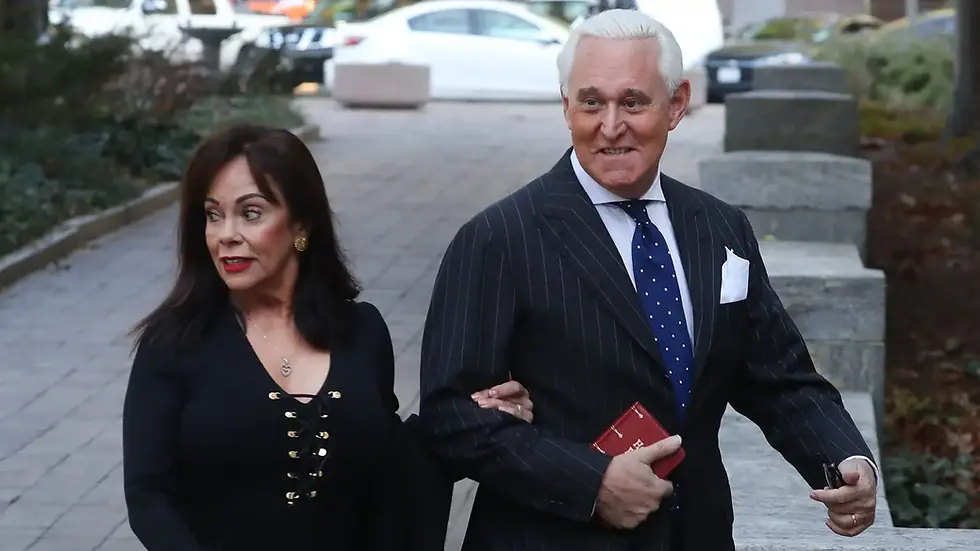
A little-known but significant piece of this picture concerns Nydia Bertran, one of the highest-ranking international officials of Soka Gakkai and the wife of Roger Stone, the controversial Republican strategist regarded as the architect of some of Donald Trump’s most aggressive campaigns. This connection directly links Soka’s organizational machinery and global soft power to circles within the American political right, suggesting possible intersections between religious lobbying, electoral strategies, and international influence.
Cults and Intelligence: Foreign Policy Subcontracting
Scholar Jeffrey M. Bale, an expert on political and religious extremism as well as covert operations, clearly outlined in the May 1991 issue of Lobster a point often overlooked in public debate: when discussing “cults,” attention typically focuses on their internal abuses and the mental control exerted over members. Even when their political activities emerge—such as support for specific parties or infiltration of state institutions—these are dismissed as eccentric maneuvers by fanatics. In reality, many of these organizations pursue genuine political agendas, sometimes in coordination with governments or intelligence agencies.
Bale cites the Unification Church as a striking example. He writes:
In the wake of Contragate, a theme which has been constantly reiterated in the press is that of the so-called ‘privatisation’ of U.S. foreign policy. (…) At the very least, the process is better described as the ‘contracting out’ of specific tasks by government agencies to sympathetic non-governmental organizations, which should therefore be viewed as subcontractors rather than independents. Nor should one overlook the possibility that certain ostensibly private organizations are nothing more than front groups for intelligence agencies.
This dynamic also extends to those who defend “cults” as part of an institutional mission—the so-called cult apologists. These organizations appear to promote a hidden agenda, masked as the defense of civil liberties, but in reality aimed at steering public discourse within the ideological and religious boundaries of their own constituencies. Bale himself does not hesitate to write, in the second volume of The Darkest Side of Politics, that in unconventional warfare a role is also played by organizations promoting “political and religious agendas which, in the name of religious and democratic freedoms, actually aim to defend extremist, totalitarian, and anti-democratic groups from investigation, criticism, and possible state repression, and more generally to resist or even roll back secular humanism, liberalism, and modernism in the West.”
Conclusion
From the White House to the corridors of the National Diet of Japan, from the jungles of Central America to the halls of the South Korean Congress, certain Eastern religious movements have managed to insinuate themselves into every fissure of power and into the fault lines where politics and religion intersect. Very different in doctrine yet similar in the pragmatism of their alliances, these organizations have shown that the boundaries between faith and geopolitics are fragile and easily crossed when money, influence, and electoral consensus are at stake.
Soka Gakkai, with its political arm Komeito, has for decades consolidated an alliance with the Liberal Democratic Party, the same political camp linked to the Church of Sun Myung Moon. The latter, for its part, has passed through scandals such as Koreagate, Iran-Contra affair, and today the “Unification Church Gate.”
The current case, with a former president and his wife imprisoned over ties to a cult, is therefore not an exception but yet another piece of a mosaic that, for decades, tells the story of religious movements that have made earthly power their most celestial mission—and politics their true altar.


Comments